
Dental Implants in Hagerstown MD
Dental implants in Hagerstown MD take more than a surgical routine. It takes a specialist who understands the full picture, from bone quality and bite mechanics to long-term restoration outcomes. Patients seeking dental implants can find that level of care at Mid-Maryland Oral & Maxillofacial Surgery, PA, where Dr. William E. Zwack, DDS, FACS, and Dr. Ayesha Nawab, DMD, MD, FACS bring dual training as both dentists and medical doctors, along with Fellow status in the American College of Surgeons, a credential reserved for surgeons who meet the highest standards of skill and professional ethics. Their approach is grounded in precision, individualized treatment planning, and a genuine commitment to each patient’s long-term oral health.

The Hidden Cost of Leaving a Gap Untreated
Most people focus on the visible gap when a tooth is lost, but the more significant problem is what happens underneath the gumline. The jawbone depends on tooth roots to stay stimulated. Every time you bite and chew, that pressure signals the bone to maintain its density and volume. Without a root in place, that signal disappears, and the bone begins to resorb. Studies show that up to one-third of jaw width can be lost within the first year after extraction alone, a process that continues silently for years if the gap is left untreated.
That bone loss does more than weaken the jaw. It narrows your options. Neighboring teeth lose lateral support and begin to tilt into the gap, which disrupts your bite and can accelerate wear on surrounding teeth. The opposing tooth, with nothing to meet, may begin to over-erupt. For patients exploring dental implants in Hagerstown, acting before significant bone loss occurs often means a simpler path to treatment. Adequate bone on hand means no grafting, fewer appointments, and a shorter overall timeline. Hagerstown dental implants placed while sufficient bone remains tend to integrate more predictably and support a stronger, longer-lasting restoration than those placed after years of resorption have taken hold.
How We Address Every Stage of Tooth Loss With Implants
Implant Placement
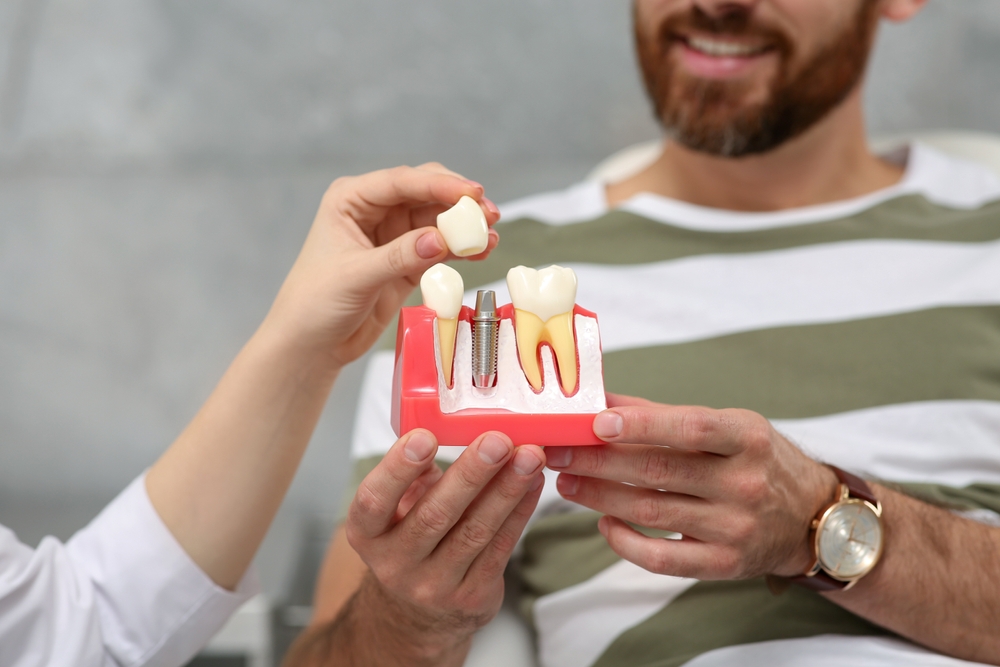
The dental implant post is the foundation everything else depends on, which is why placement accuracy is the most critical variable in the entire process. Each post must be positioned at the right depth, angle, and proximity to vital structures to support proper osseointegration and a natural-looking final restoration. Our surgeons plan every dental implant placement using 3D imaging before the procedure begins, translating that plan precisely in the operatory so the titanium post integrates reliably with your bone and anchors your replacement tooth for the long term.
Missing Upper & Lower Teeth
Full arch tooth loss in the upper or lower jaw calls for a different level of surgical planning than single dental implant placement. The number of implants needed, how they are angled, and what type of prosthetic they will support all depend on how much bone remains, where it is located, and what your daily functional demands are. Our team evaluates each of these variables individually and presents you with dental implant options that are matched to your anatomy, not just a standard protocol applied to every full-arch case we see.
Bone Grafting for Implants
Bone grafting for implants is not a setback. It is a preparatory step that makes dental implant placement possible when the jaw has lost volume after tooth loss or extraction. The type of graft used, where it is placed, and how long it needs to heal before dental implant placement can proceed all depend on how much bone has been lost and in which area of the jaw. Some patients require socket preservation at the time of extraction to prevent resorption before it starts; others need ridge augmentation or sinus grafting months later to rebuild what was lost.
Implant-Supported Overdenture
For patients who have worn conventional dentures and struggled with instability, slipping, or restricted food choices, an implant-supported overdenture addresses the root cause rather than just the symptoms. The prosthesis connects to dental implants through precision attachments, which means it stays put during meals and conversation without relying on suction or adhesive. Because the dental implants stimulate the jawbone directly, the progressive bone loss that continues under a conventional denture is significantly reduced, preserving the facial structure and making future adjustments less likely to be needed.
What to Expect at Every Stage of Care
Why Choose Us for Dental Implants
Dental implant outcomes are directly tied to surgical skill, and the credentials of your surgeon matter. Dr. Zwack and Dr. Nawab are both fully trained as dentists and as medical doctors, a level of preparation that gives them a more thorough understanding of the anatomy, pharmacology, and systemic factors that influence dental implant success. Their FACS designation is not a marketing title; it reflects recognition by peers for exceptional surgical standards and professional ethics. For patients requiring bone grafting, sinus augmentation, or full-arch dental implant reconstruction, having all of that expertise available under one roof means fewer handoffs, tighter coordination, and better overall results.
We also believe that a well-informed patient is a more confident patient. Before any dental implant procedure begins, we use cone beam CT imaging to build a precise surgical plan and walk you through every detail. We discuss sedation options candidly, keep timelines realistic, and make sure every question is answered. For patients researching Hagerstown dental implants, our team offers a care experience that pairs clinical rigor with transparency, respect for your time, and a genuine commitment to your long-term oral health goals.

You Have More Options for Dental Implants in Hagerstown MD Than You Think
A dental implant is one of the most durable, functional, and health-preserving solutions available for missing teeth, and the right surgical team makes all the difference in achieving a result that lasts. Mid-Maryland Oral & Maxillofacial Surgery, PA offers the specialist-level expertise, advanced imaging, and patient-first care that the dental implant process demands.
Dr. William E. Zwack, DDS, FACS, and Dr. Ayesha Nawab, DMD, MD, FACS are ready to evaluate your situation and build a plan that works for your specific needs. Follow us on Facebook for practice updates, oral health tips, and patient resources, then get in touch at 301.694.2300 to schedule your dental implant consultation and take the first step toward a stronger, healthier smile.
FAQs
What makes someone a poor candidate for dental implants?
Most adults in reasonable health qualify for dental implants, but certain conditions can complicate or delay treatment. Uncontrolled diabetes, active gum disease, heavy smoking, and insufficient bone volume are the most common factors that affect candidacy. Some of these, like gum disease or bone loss, can be addressed before implant placement proceeds. A thorough evaluation with Dr. Zwack or Dr. Nawab is the most reliable way to determine where you stand and what, if anything, needs to be resolved first.
Can a dental implant be placed the same day a tooth is removed?
In some cases, yes. Immediate dental implant placement at the time of extraction is possible and can reduce the overall number of appointments. Whether it is appropriate depends on the condition of the socket, the presence of infection, and how much bone surrounds the extraction site. When those factors are favorable, same-day placement simplifies the process without compromising outcomes. Your surgeon will assess the site during your consultation and let you know if immediate placement is a viable option for your situation.
What is osseointegration and why does it determine implant success?
Osseointegration is the process by which the jawbone grows around and bonds to the titanium implant post, creating the stable foundation that makes dental implants function like natural tooth roots. Without successful osseointegration, the implant cannot support a crown, bridge, or overdenture reliably. The process takes several months and is influenced by bone quality, oral hygiene, and whether the patient avoids habits like smoking that interfere with healing. Patients seeking dental implants in Hagerstown should understand that this phase, though invisible, is the most critical part of the entire treatment.
How many implants do you actually need to replace multiple missing teeth?
The number of dental implants needed depends on how many teeth are missing, where they are located, and what type of restoration is planned. A single missing tooth requires one implant, while a full arch can often be supported by four to six implants using an overdenture or fixed bridge design. Replacing every tooth individually with its own implant is also possible but requires more implants and is typically the most involved option. Hagerstown dental implants patients receive a recommendation based on their specific bone structure and restoration goals, not a one-size-fits-all number.
What role does the oral surgeon play versus the restorative dentist?
The oral and maxillofacial surgeon, Dr. Zwack or Dr. Nawab in this case, handles the surgical phases of dental implant treatment, including any preparatory procedures like bone grafting, the implant placement itself, and post-surgical follow-up through osseointegration. The restorative dentist takes over once healing is confirmed, fitting and securing the final crown, bridge, or overdenture onto the implant. Both providers work from a shared treatment plan to ensure the surgical outcome supports the restoration your dentist has designed. Clear communication between both teams is essential to a result that looks and functions as intended.